
on 4 November, 2026
Wide-Format Printing and Scanning for Houston Engineering and Energy Teams
Most Houston engineering and energy offices need a 36-inch plotter for sets and check plots, a way to scan redlines and legacy drawings, and a service partner close enough to keep both running through a deadline.
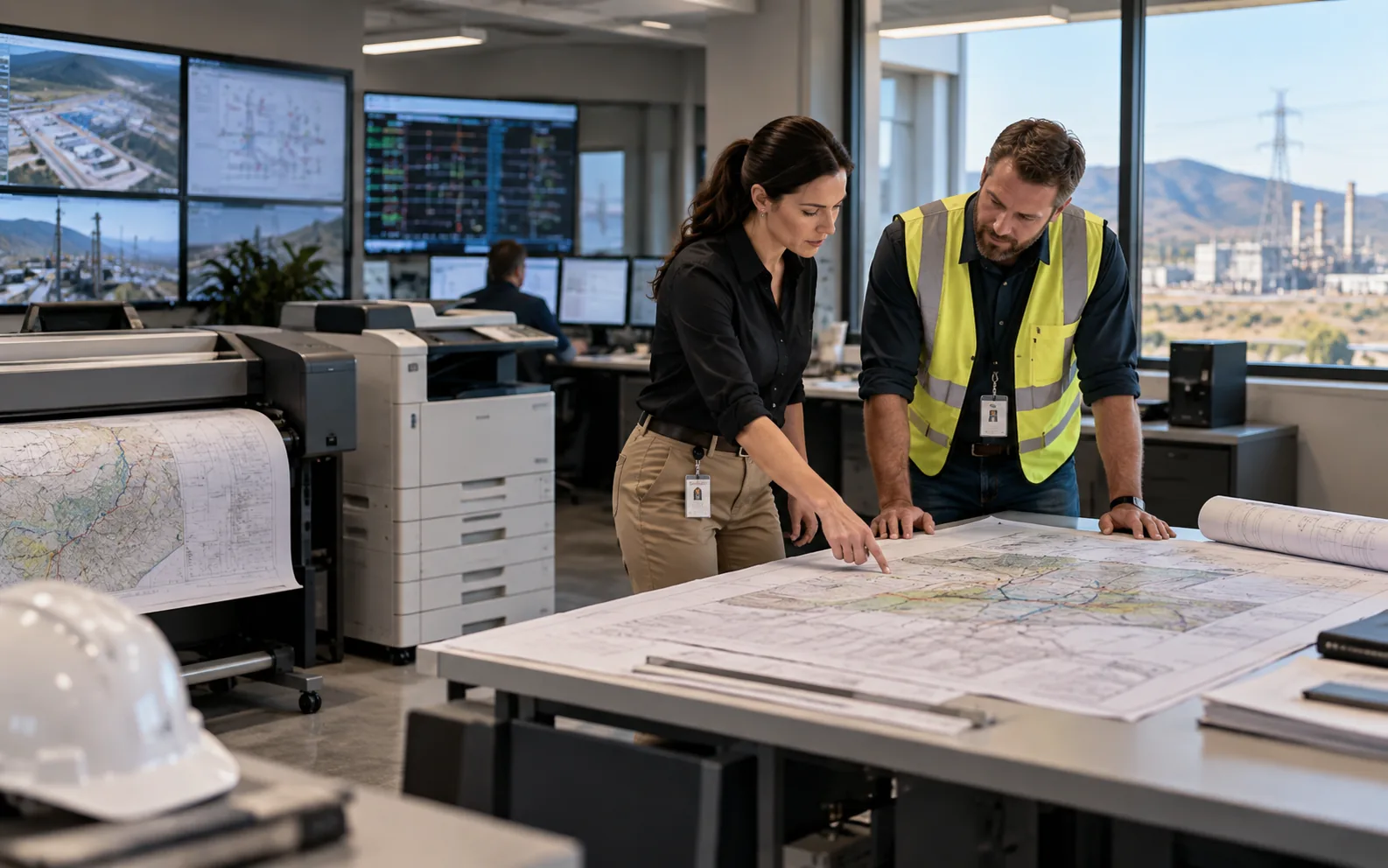
Houston's engineering and energy teams print and scan large drawings every day: plan sets, P&IDs, GIS and survey maps, and as-built drawings. Most offices are best served by a 36-inch plotter for full sets and check plots, a wide-format MFP or scanning setup to capture field redlines and legacy drawings, and a service partner close enough to fix a plotter before a turnaround or bid deadline slips. DEX Imaging supplies and services HP DesignJet, Canon imagePROGRAF and Epson wide-format equipment from its Houston office on West Sam Houston Parkway North.
Why Houston runs on large-format drawings
The Greater Houston Partnership counts more than 4,200 firms in oil and gas and advanced energy technology in the region, and nearly 79,000 engineers, architects and related technicians working in Houston. The Houston-Pasadena-The Woodlands metro area, about 7.9 million people across 10 counties, gained 126,720 residents between July 2024 and July 2025, more than any other U.S. metro, according to the Census Bureau.
Operators, engineering firms, contractors and surveyors all produce drawings that still get printed, marked up in the field and scanned back into the record. That is a different job from the posters and signage most wide-format marketing is built around.
What engineering and energy teams print and scan
- Plan sets and construction drawings. Usually D or E size. Canon's imagePROGRAF documentation lists ARCH D at 24 x 36 inches, ANSI D at 22 x 34, ARCH E at 36 x 48 and ANSI E at 34 x 44.
- P&IDs. Piping and instrumentation diagrams use symbols standardized in ANSI/ISA-5.1, which ISA describes as a uniform way to depict instrumentation and control functions on drawings such as P&IDs. They are dense, with small text and fine lines, so plot quality and scan resolution both matter.
- GIS, survey and pipeline maps. Alignment sheets, right-of-way maps, plats and site surveys often run long and in color, so color layers and long-plot support matter.
- One-line diagrams for substations and electrical systems, where a drifting line weight can change how a drawing reads.
- As-built drawings and field redlines. Marked-up sets come back from the field and need to be scanned so the changes become part of the record.
P&IDs carry extra weight in this region's petrochemical plants. Under OSHA's Process Safety Management standard (29 CFR 1910.119), P&IDs are part of the process safety information for covered processes, the management-of-change paragraph requires that information to be updated when a change affects it, and process hazard analyses must be updated and revalidated at least every five years. That is why P&ID sets get reprinted, marked up and rescanned so often around projects and turnarounds. Your process safety team decides what the standard requires; the print and scan setup just has to keep pace.
Plotter or wide-format MFP?
A plotter prints. A wide-format MFP is a plotter with a built-in scanner, so it can also copy and scan. Which one fits depends on how much you scan.
| Setup | Best for | Watch for |
|---|---|---|
| Plotter (print only) | Offices that print far more than they scan | Scans still need a separate scanner or service |
| Wide-format MFP | Teams that copy and scan redlines and as-builts every week | Fragile originals are risky in a feed-through scanner |
| Plotter plus a scanning project | Large backlogs of legacy drawings | Turnaround time and handling of originals |
For a sense of what a wide-format MFP does, HP's datasheet for its DesignJet T850 36-inch multifunction printer lists a 36-inch scan width, scanning up to 600 dpi, output to PDF, TIFF and JPEG, and scan to email, network folders and USB.
Questions to answer before you choose:
- How many D and E sheets do you print each month, and how much is color? GIS work pushes color volume up; P&IDs and plan sets are mostly line work.
- What width do you need? The short side of ARCH and ANSI D and E sheets is 36 inches or less, so a 36-inch model handles all four. Wider models give room for oversized maps.
- How often do you scan, and what? Weekly redlines favor an MFP. A one-time backlog of old drawings may be better as a project.
- Where do scans go? Project folders, a document management system or the cloud. Set that up on day one.
- Do field offices or site trailers need their own plotter? DEX specifies equipment for yards, substations and site trailers and services it from local branches.
DEX's wide-format line also includes signage printers, which are built for color graphics rather than line-accurate drawings. If your firm also does architectural and construction work, see our guide to how wide-format printers support architects and the construction industry.
Scanning legacy drawings
Many Houston firms and facility owners still keep decades of drawings in flat files and on rolls. Hurricane Harvey is the local reminder of why that matters: in 2017, NHC recorded 36 to 48 inches of rain in the Houston metro area, and 9 of the 19 official river gauges in Harris County reached all-time high flood stages. A scanned and backed-up drawing survives a flooded plan room.
- Inventory and triage. Count sheets by size and condition. Set aside torn, taped or brittle originals for special handling.
- Choose a resolution. The National Archives' rule for federal agencies digitizing permanent records (36 CFR 1236.50) sets a minimum of 300 ppi for modern text documents and 400 ppi at original size for drawings and other records with fine detail, and calls for higher resolution where the smallest detail is 1.0 mm or less. Private companies are not bound by it, but it is a solid benchmark. The same rule notes that raising a ppi setting may not add real detail, so rely on the scanner's actual optical resolution.
- Choose file formats. For permanent federal records, 36 CFR 1236.48 accepts TIFF, JPEG 2000, PNG and PDF/A. PDF/A works well for drawing sets people need to search and share.
- Name and index consistently. Use drawing number, sheet, revision, facility and date so a P&ID can be found by unit or tag later.
- Check quality before the full run. Zoom in on a sample to confirm the smallest text and finest lines are legible, and keep originals until the scans are verified.
- Store and back up the files. Route scans into document management or cloud storage. DEX's scanning and capture services add OCR and indexing so scanned documents become searchable records.
Service considerations for wide-format in Houston
- Plan around deadlines. Schedule preventive maintenance and stock ink, printheads and media ahead of turnarounds, bid dates and project closeouts.
- Keep media conditioned. HP specifies the T850's line accuracy at 23°C (73°F) and 50 to 60 percent relative humidity on specified media. In Houston, that means storing rolls indoors in air-conditioned space, not in a warehouse or trailer.
- Use rental for peaks. DEX offers wide-format rental for projects and peak demand, alongside purchase and lease.
- Secure the output. Drawings of plants and pipelines are sensitive. On office MFPs, badge-authenticated secure release holds jobs until the user is at the machine, so ask how plotter output and scan destinations will be secured too.
- Get local service. DEX backs wide-format equipment with local DEXperts and the DEX Declaration, DEX's guaranteed four-hour response to qualifying emergency service calls. Confirm coverage for each of your addresses with the Houston office.
Talk to a Houston DEXpert
DEX's Houston office, at 5821 West Sam Houston Parkway North, Suite 400, serves Houston, Cypress, Katy, Jersey Village and the surrounding area. A DEXpert can match a plotter or wide-format MFP to your drawing volume and media and set up scanning for legacy sets. See DEX's wide-format equipment and energy, mining and utilities pages, or request a quote.
Frequently asked questions
What size plotter does an engineering office need?
A 36-inch model handles ARCH and ANSI D and E sheets, since the short side of each is 36 inches or less. Choose a wider model only if you print oversized maps or graphics.
What resolution should engineering drawings be scanned at?
A useful benchmark is the National Archives' rule for federal agencies: at least 400 ppi at original size for drawings and other fine-detail records, and more where details are 1.0 mm or smaller.
Is a wide-format MFP better than a plotter?
If your team copies or scans redlines and as-builts every week, yes. If you mostly print, a plotter plus an occasional scanning project is simpler.
Does DEX service plotters in Houston?
Yes. DEX services wide-format equipment from its Houston office, backed by the DEX Declaration's four-hour response to qualifying emergency calls. The office can confirm coverage for your address.
Can we rent a plotter for a project or turnaround?
Yes. DEX offers wide-format rental for projects and peak demand, alongside purchase and lease.